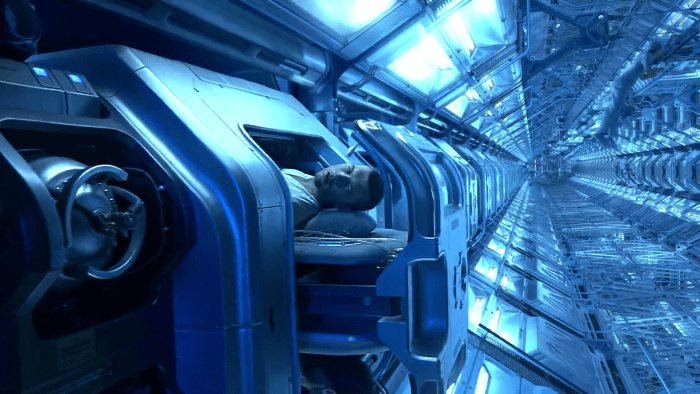
Before diving into the topic, we should know about cryonics because the topic cryopreservation is a sub-topic of cryonics.😏
What is cryonics?
Cryonics is the low -temperature freezing (at −196 °C or 77.1K) and storage of human corpse or detached head, with the hope that resurrection may possible in the future.
The science used in this practice is not a normal science that we are using the present day, it is viewed as pseudoscience and its practice has been characterized as dishonesty.
And it’s all about cryonics.
NOW ABOUT CRYOPRESERVATION:
– It’s a process where organs, cells, tissues, or any other biological constructs are cooled at the temperature below -196 degrees celsius in liquid nitrogen.
– Cryopreservation methods seek to reach low temp. without causing additional damages caused by the formation of ice crystals during freezing.
IN THIS WE WILL LEARN ABOUT PRESERVING HUMAN BODY(UNDER CRYOPRESERVATION):
Cryonics is one extreme of cryopreservation where the whole body is frozen in the hope that one day it will be possible to revive it.
But scientists agree that preserving and reawakening the complete human body is a remote possibility that would take massive breakthroughs in technology. so the science behind it is pseudoscience as above stated.
you can never say never in science but there was little chance of it happening based on current knowledge.
After death, the patient should be preserved within minutes in liquid nitrogen at a temperature below -196 degrees celsius. some experts are well trained in this technique to preserve the human body at such a low temperature.
At this stage, dry ice is used to keep the body at a low temperature. Once at the storage facility, patients are infused with cryoprotectants (like antifreeze) to prevent ice crystal formation – which would kill cells – before the temperature is slowly lowered and they are preserved in liquid nitrogen at extremely low temperatures of below-196 degrees celsius. The low temperatures are needed to allow the cells to survive dehydration after death – but uncontrolled dehydration and freezing are also lethal to living cells, so it has to be done carefully. The eventual aim is that one day they will be rewarmed and revived, but there is no evidence or guarantee that they can be.
Several hundred people have already paid to have their bodies cryogenically preserved in three existing facilities in the US and Russia, and there are as many as 1,250 on waiting lists.
How much does it cost?
Prices with other organizations can be as much as $200,000 or more for whole body cryopreservation and $80,000 for a “neuro” (head-only) option. With CI, whole-body cryopreservation costs as little as $28,000.00, rendering an alternative “neuro” option unnecessary.
Are you curious about knowing the first man to be cryopreserved in the world?
“Yes, Mr. Bedford is here.”Bedford was the first human to be cryonically preserved—that is, frozen and stored indefinitely in the hopes that technology to revive him will one day exist. He’s been at Alcor since 1991.
Mr. Bedford is referred to as Dr. James Hiram Bedford, a former University of California-Berkeley psychology professor who died of renal cancer on Jan. 12, 1967.
He was the first of 300 bodies and brains currently preserved in the world’s three known commercial cryonics facilities: Alcor; the Cryonics Institute in Clinton Township, Michigan; and KrioRus near Moscow.
Permafrost is any ground that remains completely frozen—32°F (0°C) or colder—for at least two years straight. These permanently frozen grounds are most common in regions with high mountains and in Earth’s higher latitudes—near the North and South Poles. And it covers large regions of the Earth.
And it covers 24% of the exposed land surface(is about 22.7 square kilometers) of the northern hemisphere.
How Does Permafrost Form?
A pool of underground water or puddle of water that freezes over the winter night, water that is trapped in sediment, soil, and the cracks, crevices, and pores of rocks turn to ice when ground temperatures drop below 32°F (0°C). And remain frozen for two consecutive years, it is called permafrost.
Where Is Permafrost Found?
It is found in areas where temperatures rarely rise above freezing. This means the permafrost is often found in Arctic regions such as Greenland, the U.S. state of Alaska, Russia, China, and Eastern Europe.
Ecological consequences:
In the northern circumpolar region, permafrost contains 1700 billion tons of organic material equaling almost half of all organic material in all soils. And the amount of carbon produced in permafrost by the global warming effect is four times the carbon that has been released to the atmosphere due to human activities in modern times.
One gram of soil from the active layer may include more than one billion bacteria cells.f placed along with each other, bacteria from one kilogram of active layer soil will form a 1000 km long chain. The number of bacteria in permafrost soil varies widely, typically from 1 to 1000 million per gram of soil.
Organism preserved in permafrost:
Microbes, Scientists predict that up to 1021 microbes, including fungi and bacteria in addition to viruses, will be released from melting ice per year.
Plants, silene stenophylla is revived from 30,000-year-old tissue found in an ice age squirrel burrow in the Siberian permafrost.
Animals include a male steppe bison, a woolly rhinoceros, a mummified pony, and several mammoths.
In 2018, a well-preserved bird was discovered by local fossil ivory hunters 30 km east of the village of Belaya Gora, Yakutia, in northeastern Siberia. The bird carcass was found approximately 150 meters (492 feet) into an ice tunnel that had been hydraulically mined into the permafrost at a depth of roughly 7 meters below the earth’s surface. So it was somewhat surprising (and quite exciting) when radiocarbon dating revealed that the lark died sometime between 44,163–48,752 years BP — in the middle of the last Ice Age.
 Exotic Science & Technology